Map
在go 1.24中,对于map的存储更换了新的存储方法,使用Swiss table的方式存储数据,优化了map的操作,下面我们展开讨论map的实现,以下表述默认 64 位架构
首先是简介对hash冲突的解决方法,因为某个 key 应该落在哪个槽位,主要由哈希函数 hash(key) 决定。哈希函数把每个 key 映射为一个整数:同一个 key 总是映射到同一个整数;所以会存在hash冲突问题,下面我们简单介绍开放寻址哈希表方法。
开放寻址哈希表
在开放寻址哈希表中,所有条目都存放在同一个底层数组中。数组中的每个位置称为一个 slot(槽位)。不同 key 理想情况下应当遵循均匀随机的整数分布。开放寻址哈希表的定义性特征在于:它通过把 key 存到数组中的其他位置来解决碰撞。因此,如果目标 slot 已经满了(发生碰撞),就使用探测序列(probe sequence)去尝试其他 slot,直到找到一个空 slot。
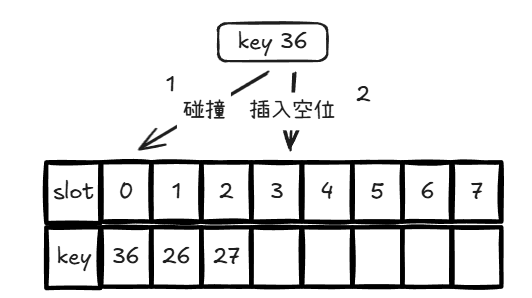
swiss table
Swiss Table 同样是开放寻址哈希表的一种形式。仍然使用单一底层数组进行存储,但会把数组按逻辑划分为每组 8 个 slot 的 group(组)。此外,每个 group 还有一个 64 位控制字(control word)作为元数据。控制字的 8 个字节分别对应该 group 的 8 个 slot。每个字节的值表示对应 slot 是空、已删除,还是正在使用。如果正在使用,该字节还包含该 slot 的 key 的哈希值低 7 位(称为 h2)。例如:
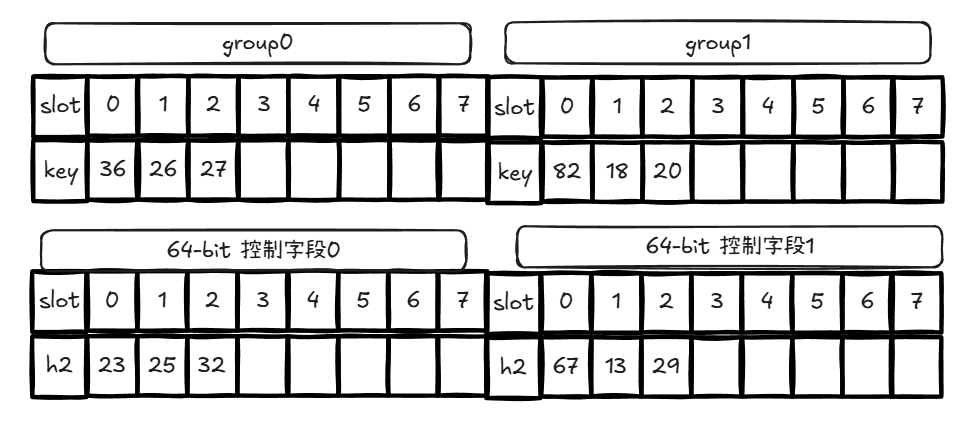
在Swiss Tables中会对hash(key)得到的值,并把哈希拆成两部分,分别为h1(高 57 位)和h2(低 7 位)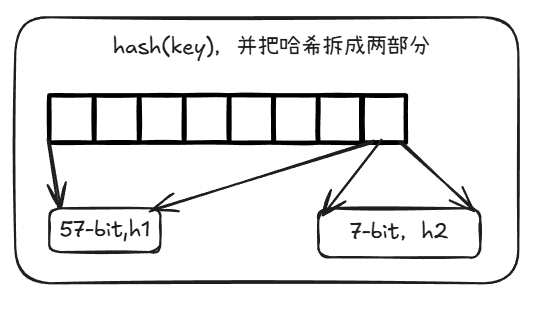
在插入操作中:
- hash(key)计算拆分得到h1和h2
- 根据h1计算首先需要查询的group, h1 % group的数量
- 在group内,判断slot是否可以插入or包含key(此时为更新操作)
- 如果没有slot包含key,则寻找empty 插入key
- 如果没empty,则沿探测序列继续搜索下一个 group
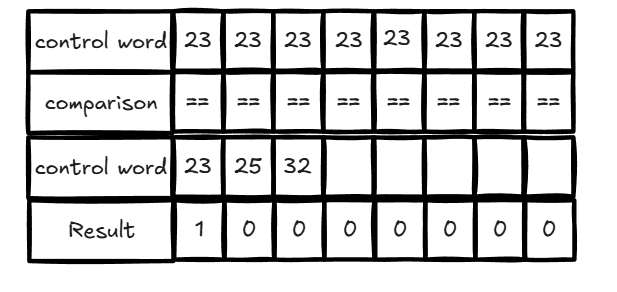
在第三步就是swiss table做的优化,一个 group有8个slot,正常是线性扫描并比较 8 个 key,但存在控制字可以进行快速比较,通过比较控制字中的每个字节为我们的h2,得到候选(一次比较同一 group 的 8 个 slot 控制字节,从而优化)
例如查找 key 36,并且 h2 = 23:
map的基本使用
创建map
有两种创建方式分别是带容量和不带容量的创建:
1 | m := make(map[int]int, cap) |
map写入数据
1 | m[key] = val |
map读取数据
- 第一种方式如果key不存在返回0值,存在返回对应val
- 第二种方式可以根据返回的bool值判断是否真的取到值
1
2v1 := m[key]
v2, ok := m[key]
map删除数据
1 | delete(m, key) |
map数据结构
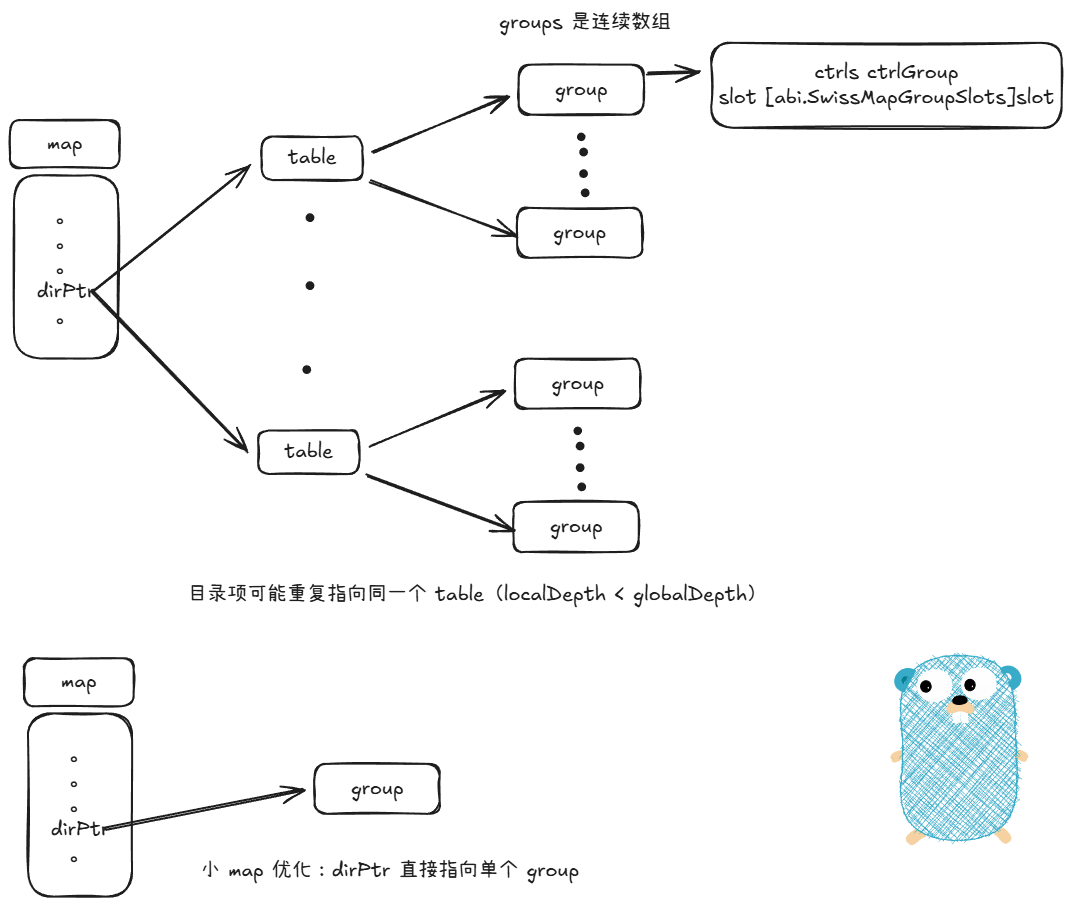
internal/runtime/maps/map.go
1 | type Map struct { |
- used 已经填充的slot的数量(所有table中的元素的总数)
- seed 用于hash计算使用
- dirPtr 通常情况下,dirPtr 指向一个由 table 指针组成的数组,如果map中元素数量不超过 8 此时 dirPtr 直接指向一个单独的 group
- globalDepth 在table目录查找时要使用的比特数
- globalShift 在进行目录查找时,需要从哈希值中右移掉的比特数
- writing 是一个标志位:当 map 正在被写入时,会通过异或 1(XOR 1)的方式翻转。
- clearSeq 是对 Clear 调用次数的序列计数器,用于在迭代期间检测 map 是否被清空。
internal/runtime/maps/table.go
1 | type table struct { |
- used 该table已填充的的元素(slot)数量
- capacity 该table的容量,slot的上限
- growthLeft 在无需rehash的情况下,还能继续填充的 slot 数量。(used + tombstones > loadFactor*capacity 时会触发 rehash)
- localDepth 在该 table 之上,用于目录查找(directory lookups)的比特数。(如果目录扩容但该table未拆分可能会小于m.globalDepth)
- index 该 table 在 Map 目录中的索引。这是目录中该 table 出现的“第一个”位置的索引。同一个 table 可能会在目录中连续出现多个索引位置。如果index为-1则已过期不再使用
- groups table 自己持有的一个 group 数组
internal/runtime/maps/group.go
1 | type groupsReference struct { |
- data 指向一个 group 数组
- lengthMask 等于 data 中 group 的数量减一,方便按位
internal/rutime/maps/group.go
1 | type groupReference struct { |
用来表示存放在 data 中的单个 slot group, 一个group包含 abi.SwissMapGroupSlots (8)个 slot(key/elem 对),以及它们的控制字。
创建map
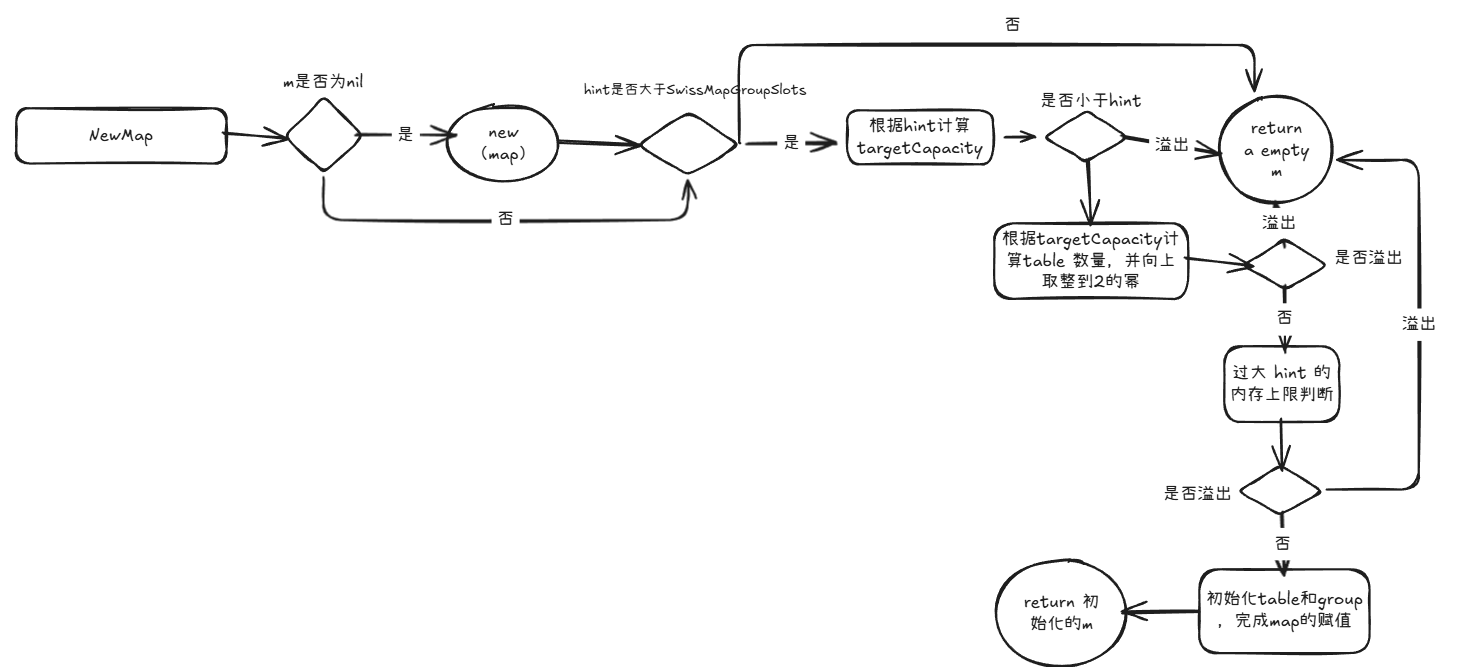 **internal/runtime/maps/map.go NewMap()**
1 | func NewMap(mt *abi.SwissMapType, hint uintptr, m *Map, maxAlloc uintptr) *Map { |
该方法有四个参数,mt *abi.SwissMapType:map 的类型元数据,hint uintptr:来自 make(map[K]V, hint) 的期望容量,m *Map:可复用/预分配的 Map 头部指针;maxAlloc uintptr:本次分配允许的最大内存上限;
由于代码过长且判断条件较多所以就划分讲解:
step1:
- 编译器判断 map 逃逸,就不在栈上预分配,直接传 nil,NewMap 会 new(Map),且因为指针要返回给调用方,这个 Map 会逃逸,实际分配在堆上。
- 编译器判断 map 不逃逸,就在调用方栈上放一个临时 Map 头部,并把它的地址传给 NewMap 复用。
1
2
3
4
5
6
7func NewMap(mt *abi.SwissMapType, hint uintptr, m *Map, maxAlloc uintptr) *Map {
if m == nil {
m = new(Map)
}
//..
return m
}
step2:
对m的seed赋值,并根据hint大小:判断当hint <= abi.SwissMapGroupSlots(=8) ,此时一个group即可满足,函数直接返回不分配;在对map首次写入时会分配一个 8-slot group
1 | func NewMap(mt *abi.SwissMapType, hint uintptr, m *Map, maxAlloc uintptr) *Map { |
step3:
计算 targetCapacity = hint * slotsPerGroup / maxAvgGroupLoad,等价于 hint / 负载因子(7/8),防止刚创建后就触发扩容,如果计算分配的预期容量溢出转为则直接返回空map。
1 | func NewMap(mt *abi.SwissMapType, hint uintptr, m *Map, maxAlloc uintptr) *Map { |
step4:
计算 table 个数dirSize = ceil(targetCapacity / maxTableCapacity) ,随后向上取整到 2 的幂;溢出则返回空 map
1 | func NewMap(mt *abi.SwissMapType, hint uintptr, m *Map, maxAlloc uintptr) *Map { |
step5:
进行过大 hint 的内存上限检查:用 dirSize*maxTableCapacity 得到总 groups 上界,再乘 mt.GroupSize 得到内存上界;任一处溢出或超 maxAlloc 则返回
1 | func NewMap(mt *abi.SwissMapType, hint uintptr, m *Map, maxAlloc uintptr) *Map { |
1 | 计算目录需要用的位数,以及取出这 globalDepth 位,哈希值需要右移多少位。然后创建table(容量为预期容量 / table个数)并分配目录数组,记录目录长度,初始化完成返回 |
接下来看上面调用到的创建table的方法newTable()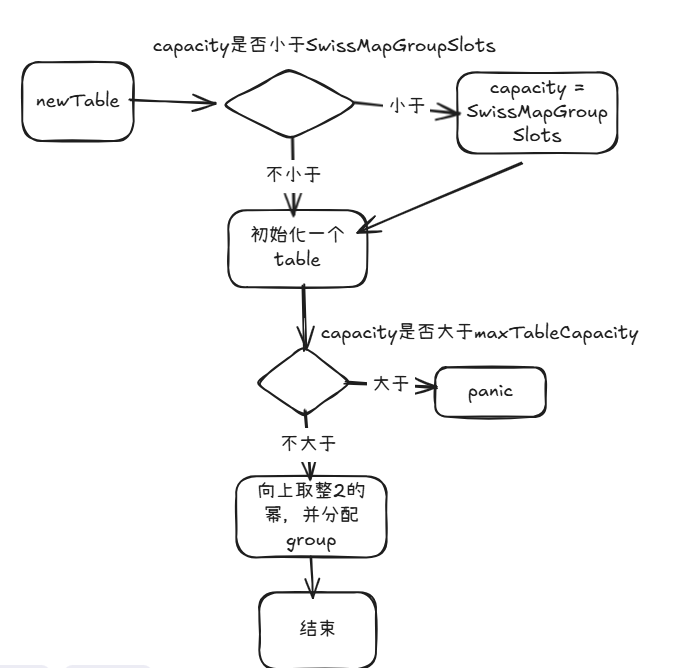
internal/rutime/maps/table.go newTable()
- 首先根据capacity大小进行兜底,避免不够一个group的slot容量,然后对table赋值
- 如果capacity > maxTableCapacity(1024)则panic
- 然后将capacity对齐到 2 的幂,如果对齐后溢出panic
- 调用reset 方法会按容量分配 groups 数组、设置 capacity/ growthLeft,并把 control 字节初始化为 empty。
- 返回创建好的table
1
2
3
4
5
6
7
8
9
10
11
12
13
14
15
16
17
18
19
20func newTable(typ *abi.SwissMapType, capacity uint64, index int, localDepth uint8) *table {
if capacity < abi.SwissMapGroupSlots {
capacity = abi.SwissMapGroupSlots
}
t := &table{
index: index,
localDepth: localDepth,
}
if capacity > maxTableCapacity {
panic("initial table capacity too large")
}
capacity, overflow := alignUpPow2(capacity)
if overflow {
panic("rounded-up capacity overflows uint64")
}
t.reset(typ, uint16(capacity))
return t
}
对table分配group数组
table.reset()
- 根据capacity计算出groupCount
- newGroups(typ, groupCount)创建了一个groupsReference分配一段连续的 group 数组并返回,对table赋值
- 然后调用resetGrowthLeft计算growthLeft
- 最后清空整张groups表的 control 字节
1
2
3
4
5
6
7
8
9
10
11func (t *table) reset(typ *abi.SwissMapType, capacity uint16) {
groupCount := uint64(capacity) / abi.SwissMapGroupSlots
t.groups = newGroups(typ, groupCount)
t.capacity = capacity
t.resetGrowthLeft()
for i := uint64(0); i <= t.groups.lengthMask; i++ {
g := t.groups.group(typ, i) //根据index返回对应的group
g.ctrls().setEmpty()
}
}
该方法根据capacity计算当前table不扩容情况下还可以放多少数据
table.resetGrowthLeft()
- 如果 capacity 为0则直接panic,一个table必须有一个有效的容量
- 根据 capacity 计算出growthLeft,对于单 group 表需要至少留 1 个空槽来保证探测终止
- 对于多个 group 负载因子是 maxAvgGroupLoad / SwissMapGroupSlots(7/8),先做溢出检查:t.capacity*maxAvgGroupLoad 如果溢出会panic。最终可用槽数 = capacity * 7 / 8。
- 返回
1
2
3
4
5
6
7
8
9
10
11
12
13
14func (t *table) resetGrowthLeft() {
var growthLeft uint16
if t.capacity == 0 {
panic("table must have positive capacity")
} else if t.capacity <= abi.SwissMapGroupSlots {
growthLeft = t.capacity - 1
} else {
if t.capacity*maxAvgGroupLoad < t.capacity {
panic("overflow")
}
growthLeft = (t.capacity * maxAvgGroupLoad) / abi.SwissMapGroupSlots
}
t.growthLeft = growthLeft
}
分配一段连续的 group 数组加初始化lengthMask方便快速查找
newGroups()
1 | func newGroups(typ *abi.SwissMapType, length uint64) groupsReference { |
map中读数据
在internal/runtime/maps/runtime_swiss.go中可以查看实现方法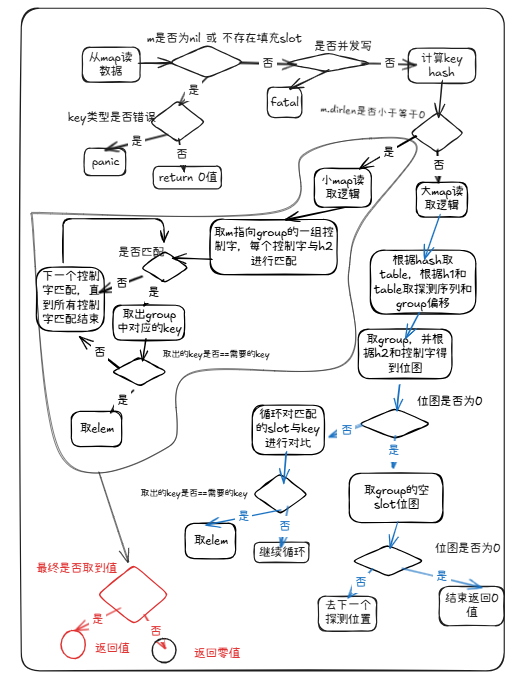
runtime_mapaccess1()
1 | func runtime_mapaccess1(typ *abi.SwissMapType, m *Map, key unsafe.Pointer) unsafe.Pointer { |
step1:
如果map为nil,或者map中无已填充的数据,首先对key的合法性进行判断,如果key不合法则直接panic,否则返回一个零值;
1 | if m == nil || m.Used() == 0 { |
step2:
此时存在其他goroutine在写该map,则直接fatal
1 | if m.writing != 0 { |
step3:
使用typ类型对应的hasher函数得到key对应的hash,如果m.dirLen <= 0说明是一个小map
则调用getWithKeySmall方法取值并返回,若没取到返回零值
1 | hash := typ.Hasher(key, m.seed) |
step4:
- 根据hash值右移globalShift获取到table的index,然后根据index取出对应的table指针
- 根据h1(hash)和group的lengthMask计算出,起始 offset 和步进序列
- 然后根据取出seq,开启for循环,每次seq.next()会给出下一个要探测的 group 位置。
- 在for循环内部,根据h2(hash)与控制字匹配,得到位图(哪些 slot 的 h2 匹配)例如:mask = 0b00001001
- 当match大于0,开启第二个for遍历,按位图逐个取,mask.first() 取最低位的 1,如果key存的是指向key的指针才解指针
- 如果typ.Key.Equal(key, slotKey)成立,则取出对应槽位的elem,并且如果elem存的是指向elem的指针才解指针,最后返回
- 如果没配对则从match中 mask.removeFirst()把最低位的 1 清掉,继续遍历直到取出或,match为空
- 如果第二个for循环没取出值,且当前组有emptyslot,说明探测序列结束,直接返回零值。
- 否则继续执行第一个for循环取出根据步进序列得出要探测的 group 位置继续执行 4 - 8操作
1
2
3
4
5
6
7
8
9
10
11
12
13
14
15
16
17
18
19
20
21
22
23
24
25
26
27
28
29
30
31
32idx := m.directoryIndex(hash)
t := m.directoryAt(idx)
seq := makeProbeSeq(h1(hash), t.groups.lengthMask)
for ; ; seq = seq.next() {
g := t.groups.group(typ, seq.offset)
match := g.ctrls().matchH2(h2(hash))
for match != 0 {
i := match.first()
slotKey := g.key(typ, i)
slotKeyOrig := slotKey
if typ.IndirectKey() {
slotKey = *((*unsafe.Pointer)(slotKey))
}
if typ.Key.Equal(key, slotKey) {
slotElem := unsafe.Pointer(uintptr(slotKeyOrig) + typ.ElemOff)
if typ.IndirectElem() {
slotElem = *((*unsafe.Pointer)(slotElem))
}
return slotElem
}
match = match.removeFirst()
}
match = g.ctrls().matchEmpty()
if match != 0 {
return unsafe.Pointer(&zeroVal[0])
}
}
接下来看一下里面用到的方法的实现首先是getWithKeySmall,该方法用于小map的key取对应的elem
Map.getWithKeySmall()
首先根据m.dirptr封装了一个group,前面也提到小map无table只有一个group
- 取出h2(hash)和group的控制字
- 开启for循环遍历(结束条件:1.i == SwissMapGroupSlots;2.找到key对应elem返回),先取低8位的第一个字节的控制位,然后将ctrls右移8位
- 如果取出的控制位!=h2则继续循环取下一个控制位
- 如果控制位==h2,首先取出index 偏移量对应的slot key,并且当存放的key为指向key指针时解指针
- 接着判断slot key 是否等于 key,如果等于取出index 偏移量对应的slot Elem,并且当存放的Elem为指向Elem指针时解指针,返回值结束;否则继续for循环直到取出
- 如果到最后还没有找到配对的就直接return false
1
2
3
4
5
6
7
8
9
10
11
12
13
14
15
16
17
18
19
20
21
22
23
24
25
26
27
28func (m *Map) getWithKeySmall(typ *abi.SwissMapType, hash uintptr, key unsafe.Pointer) (unsafe.Pointer, unsafe.Pointer, bool) {
g := groupReference{
data: m.dirPtr,
}
h2 := uint8(h2(hash))
ctrls := *g.ctrls()
for i := uintptr(0); i < abi.SwissMapGroupSlots; i++ {
c := uint8(ctrls)
ctrls >>= 8
if c != h2 {
continue
}
slotKey := g.key(typ, i)
if typ.IndirectKey() {
slotKey = *((*unsafe.Pointer)(slotKey))
}
if typ.Key.Equal(key, slotKey) {
slotElem := g.elem(typ, i)
if typ.IndirectElem() {
slotElem = *((*unsafe.Pointer)(slotElem))
}
return slotKey, slotElem, true
}
}
return nil, nil, false
}
然后是取table的操作,此时不是小map
Map.directoryIndex 和 Map.directoryAt
directoryIndex负责计算table的index,directoryA负责取出对应的table的指针
directoryIndex,如果dirLen == 1说明只有一个table直接返回0,否则将hash右移globalShift位返回
directoryAt根据传进来的index计算出table的指针地址,返回
1 | func (m *Map) directoryIndex(hash uintptr) uintptr { |
接着是取探测起始位置和探测序列函数;计算探测起始位置使用到makeProbeSeq函数,利用hash和group的lengthMask按位与得出起始位置,设置index为0并封装为probeSeq返回计算下一个探测位置用到next()函数,采用二次探测的方法,每次 next():index++,然后 offset = (offset + index) & mask
1 | func makeProbeSeq(hash uintptr, mask uint64) probeSeq { |
然后看matchH2()用来判断该group中那些slot是候选
ctrlGroup.matchH2()
1 | func (g ctrlGroup) matchH2(h uintptr) bitset { |
- bitsetLSB * h 把 8 位的 h 复制到 8 个字节里,例如 : h为00100010,计算后为 0x22 22 22 22 22 22 22 22
- g ^ 用于按位异或, 此时v中每个字节为 0 的位置就表示 g 的对应字节 等于 h;例如前面计算得到0x22 22 22 22 22 22 22 22 g为0x21 22 11 33 44 22 22 22,则得到0x03 00 33 11 66 00 00 00
- v - bitsetLSB 将每个字节减一,例如0x03 00 33 11 66 00 00 00得到:0x01 FF 32 10 64 FE FE FF
- ((v - bitsetLSB) &^ v) 按位清除(v为1的为,会把(v - bitsetLSB)的对应位清0),得到0x00 ff 00 00 00 fe fe ff
- 最后于bitsetMSB按位与 得到 0x00 80 00 00 00 80 80 80 返回遍历需要的位图
matchEmpty()用来判断该group中是否有empty slot,有的话说明探测结束,后面无slot
ctrlGroup.matchEmpty()
1 | func (g ctrlGroup) matchEmpty() bitset { |
go官方定义第 7 位被置 1 且第 1 位未置位时则该slot是一个empty slot
- v << 6 会把 每个字节的 bit1(0x02)移动到该字节的 bit7 位置。
- v &^ (v<<6) 会在 v 的 bit7 上 清掉 那些原本 bit1 为 1的字节。
- 然后使用bitsetMSB 按位与确保每个字节只保留最高位,此时0x80的字节就是空empty slot
向map中写数据
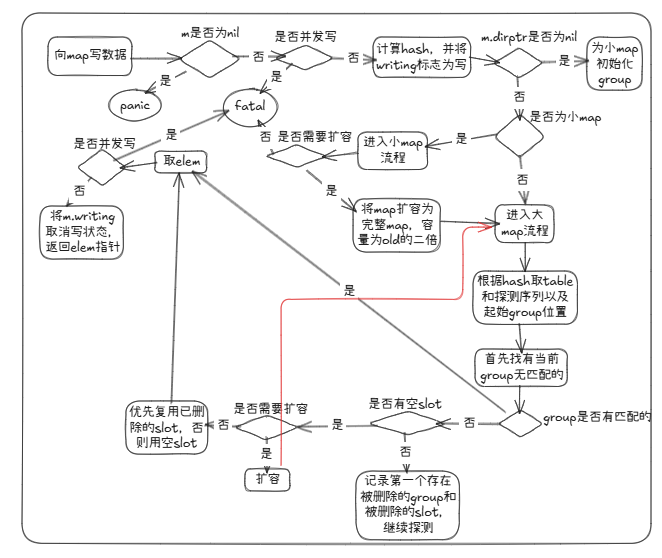
首先总结一下map写数据的大致流程:
- m == nil(nil map)写入会 panic;进入写前若 m.writing != 0 会 fatal。
- 计算 hash 后把 m.writing ^= 1(通常 0 -> 1)。
- 若 m.dirPtr == nil,先 growToSmall 分配首个 group。
- 若 m.dirLen == 0(小 map):未满:直接 small put;已满:growToTable 转成 table 再走大 map 流程。
- 大 map:按 hash 找 table,沿 probe 序列先找“同 key”槽位(找到就是更新并返回)。
没找到时:遇到 empty 表示 probe 结束;若之前记过 deleted 槽位则优先用 deleted,否则用 empty;若 growthLeft == 0 则 rehash 后 continue outer 重试。 - 返回前再做并发校验:若 m.writing == 0 则 fatal,否则再 ^= 1(1 -> 0)恢复。
1
2
3
4
5
6
7
8
9
10
11
12
13
14
15
16
17
18
19
20
21
22
23
24
25
26
27
28
29
30
31
32
33
34
35
36
37
38
39
40
41
42
43
44
45
46
47
48
49
50
51
52
53
54
55
56
57
58
59
60
61
62
63
64
65
66
67
68
69
70
71
72
73
74
75
76
77
78
79
80
81
82
83
84
85
86
87
88
89
90
91
92
93
94
95
96
97
98
99
100
101
102
103
104
105
106
107
108func runtime_mapassign(typ *abi.SwissMapType, m *Map, key unsafe.Pointer) unsafe.Pointer {
if m == nil {
panic(errNilAssign)
}
if m.writing != 0 {
fatal("concurrent map writes")
}
hash := typ.Hasher(key, m.seed)
m.writing ^= 1
if m.dirPtr == nil {
m.growToSmall(typ)
}
if m.dirLen == 0 {
if m.used < abi.SwissMapGroupSlots {
elem := m.putSlotSmall(typ, hash, key)
if m.writing == 0 {
fatal("concurrent map writes")
}
m.writing ^= 1
return elem
}
m.growToTable(typ)
}
var slotElem unsafe.Pointer
outer:
for {
idx := m.directoryIndex(hash)
t := m.directoryAt(idx)
seq := makeProbeSeq(h1(hash), t.groups.lengthMask)
var firstDeletedGroup groupReference
var firstDeletedSlot uintptr
for ; ; seq = seq.next() {
g := t.groups.group(typ, seq.offset)
match := g.ctrls().matchH2(h2(hash))
for match != 0 {
i := match.first()
slotKey := g.key(typ, i)
slotKeyOrig := slotKey
if typ.IndirectKey() {
slotKey = *((*unsafe.Pointer)(slotKey))
}
if typ.Key.Equal(key, slotKey) {
if typ.NeedKeyUpdate() {
typedmemmove(typ.Key, slotKey, key)
}
slotElem = unsafe.Pointer(uintptr(slotKeyOrig) + typ.ElemOff)
if typ.IndirectElem() {
slotElem = *((*unsafe.Pointer)(slotElem))
}
t.checkInvariants(typ, m)
break outer
}
match = match.removeFirst()
}
match = g.ctrls().matchEmpty()
if match != 0 {
var i uintptr
if firstDeletedGroup.data != nil {
g = firstDeletedGroup
i = firstDeletedSlot
t.growthLeft++
} else {
i = match.first()
}
if t.growthLeft > 0 {
slotKey := g.key(typ, i)
slotKeyOrig := slotKey
if typ.IndirectKey() {
kmem := newobject(typ.Key)
*(*unsafe.Pointer)(slotKey) = kmem
slotKey = kmem
}
typedmemmove(typ.Key, slotKey, key)
slotElem = unsafe.Pointer(uintptr(slotKeyOrig) + typ.ElemOff)
if typ.IndirectElem() {
emem := newobject(typ.Elem)
*(*unsafe.Pointer)(slotElem) = emem
slotElem = emem
}
g.ctrls().set(i, ctrl(h2(hash)))
t.growthLeft--
t.used++
m.used++
t.checkInvariants(typ, m)
break outer
}
t.rehash(typ, m)
continue outer
}
if firstDeletedGroup.data == nil {
match = g.ctrls().matchEmptyOrDeleted()
if match != 0 {
firstDeletedGroup = g
firstDeletedSlot = match.first()
}
}
}
}
if m.writing == 0 {
fatal("concurrent map writes")
}
m.writing ^= 1
return slotElem
}
该方法较长分为几步来进行阐述
step1:
向未初始化 map写入会panic;如果该map此时被其他协程写则fatal
如果此时已初始化且没有其他协程写则计算hash并将writing与1做异或(m.writing ^= 1( 0 -> 1))
1 | if m == nil { |
step2:
- 若dirptr为nil此时map还未分配group,调用growToSmall初始化一个group供map使用
- 若dirLen为0则以为着该map为小map,此时有两种情况1:当前小map未填满则进入put流程;2:小map填满了此时将小map扩容,创建一个table供当前map使用
- put 成功返回前再检查:如果 m.writing == 0 则 fatal(说明被其他协程并发写修改);否则再 (m.writing ^= 1( 1 -> 0))再返回。
1
2
3
4
5
6
7
8
9
10
11
12
13
14
15
16
17if m.dirPtr == nil {
m.growToSmall(typ)
}
if m.dirLen == 0 {
if m.used < abi.SwissMapGroupSlots {
elem := m.putSlotSmall(typ, hash, key)
if m.writing == 0 {
fatal("concurrent map writes")
}
m.writing ^= 1
return elem
}
m.growToTable(typ)
}
step3: 在前面没有返回说明不是小map,或者小map被填满触发扩容了,进入下面的outer 标签的 for循环
- 先用 hash 计算目录索引拿到 table,再得到 probe 序列和起始 group。
1
2
3
4
5
6
7
8
9
10var slotElem unsafe.Pointer
outer:
for {
idx := m.directoryIndex(hash)
t := m.directoryAt(idx)
seq := makeProbeSeq(h1(hash), t.groups.lengthMask)
var firstDeletedGroup groupReference //第一个存在删除slot的group
var firstDeletedSlot uintptr //第一个被删除的slot
//..
}
step4:
- 进入内层for 按 probe 序列继续探测(与前面读路径相似)。
- 内层for循环里,首先获得起始group然后根据h2(hash)与控制字匹配,得到位图(哪些 slot 的 h2 匹配);(与前面读路径相似)。
- 如果该group有与h2匹配的slot则:首先取得第一个匹配的key,倘若是指向key的指针的则解引用;倘若不存在不进入for match != 0 循环
- 判断与传入的key是否equal:equal则判断是否需要更新key需要的话直接基于typedmemmove将key赋给slotkey,不需要进入取elem(倘若是指向elem的指针的则解引用)并复制给slotElem,直接结束outer循环;
- 若不equal则取下一个与h2匹配的key;直到该group没有与h2匹配的slot
1
2
3
4
5
6
7
8
9
10
11
12
13
14
15
16
17
18
19
20
21
22
23
24
25
26
27
28
29
30//..
for ; ; seq = seq.next() {
g := t.groups.group(typ, seq.offset)
match := g.ctrls().matchH2(h2(hash))
// Look for an existing slot containing this key.
for match != 0 {
i := match.first()
slotKey := g.key(typ, i)
slotKeyOrig := slotKey
if typ.IndirectKey() {
slotKey = *((*unsafe.Pointer)(slotKey))
}
if typ.Key.Equal(key, slotKey) {
if typ.NeedKeyUpdate() {
typedmemmove(typ.Key, slotKey, key)
}
slotElem = unsafe.Pointer(uintptr(slotKeyOrig) + typ.ElemOff)
if typ.IndirectElem() {
slotElem = *((*unsafe.Pointer)(slotElem))
}
t.checkInvariants(typ, m)
break outer
}
match = match.removeFirst()
}
//..
}
**step5:**此时该group没有匹配到key对应的slot
- 取出当前group的空slot,若没有则不进入
- 倘若有空slot(说明探测序列要结束了),首先查看firstDeletedGroup是否为空,不为空说明已经找到第一个删除的slot和对应得Group并将t.growthLeft++,否则取出当前group中第一位空的slot
- 接着判断当前t.growthLeft是否大于0.大于0则说明可直接插入无需扩容,否则说明当前table需要扩容才能继续插入
- 倘若可直接插入取出空slot的地址,如果 key 是间接存储(槽里放指针),首先分配给key内存,把指针写进槽位,接着把传入 key 拷贝到最终 key 存储位置。
- 用槽位原始地址 + 偏移,定位到该槽位的 elem 字段。如果 elem 也间接存储,就分配 elem 内存,把指针写进槽位,并让 slotElem 指向新内存。
- 将控制位写入g的控制字并且将g和t的used++,将t.growthLeft–, 调用checkInvariants,结束outer循环
- 倘若当前插入需要rehash则rehash 后重试outer for循环
1
2
3
4
5
6
7
8
9
10
11
12
13
14
15
16
17
18
19
20
21
22
23
24
25
26
27
28
29
30
31
32
33
34
35
36
37
38//..
match = g.ctrls().matchEmpty()
if match != 0 {
var i uintptr
if firstDeletedGroup.data != nil {
g = firstDeletedGroup
i = firstDeletedSlot
t.growthLeft++ // will be decremented below tobecome a no-op.
} else {
// Otherwise, use the empty slot.
i = match.first()
}
if t.growthLeft > 0 {
slotKey := g.key(typ, i)
slotKeyOrig := slotKey
if typ.IndirectKey() {
kmem := newobject(typ.Key)
*(*unsafe.Pointer)(slotKey) = kmem
slotKey = kmem
}
typedmemmove(typ.Key, slotKey, key)
slotElem = unsafe.Pointer(uintptr(slotKeyOrig) + typElemOff)
if typ.IndirectElem() {
emem := newobject(typ.Elem)
*(*unsafe.Pointer)(slotElem) = emem
slotElem = emem
}
g.ctrls().set(i, ctrl(h2(hash)))
t.growthLeft--
t.used++
m.used++
t.checkInvariants(typ, m)
break outer
}
t.rehash(typ, m)
continue outer
}
step6:
此时该group没有配对的key也没有结束探寻
- 如果此时没有找到第一个存在删除的group,则检查当前group是否存在被删除得slot,存在的话则进行赋值,不存在则继续探测序列循环
1
2
3
4
5
6
7if firstDeletedGroup.data == nil {
match = g.ctrls().matchEmptyOrDeleted()
if match != 0 {
firstDeletedGroup = g
firstDeletedSlot = match.first()
}
}
step7:
此时找到可以写入的位置
- 先检查:如果 m.writing == 0 则 fatal(说明被其他协程并发写修改);否则再 (m.writing ^= 1( 1 -> 0))再返回slotElem。
1
2
3
4
5if m.writing == 0 {
fatal("concurrent map writes")
}
m.writing ^= 1
return slotElem
写入操作结束,接下来阐述其中用到的关键方法:
Map.growToSmall()
该方法用于小 map 路径下首次为 m 分配存储
- 创建一个包含一个group的groupsReference,将m的dirPtr指向该group的地址,并将控制位全部置为 empty。
1
2
3
4
5
6
7
8
9func (m *Map) growToSmall(typ *abi.SwissMapType) {
grp := newGroups(typ, 1)
m.dirPtr = grp.data
g := groupReference{
data: m.dirPtr,
}
g.ctrls().setEmpty()
}
Map.putSlotSmall()
该方法用于向小map写入数据,该方法主要有两个流程
第一步:当前group有与h2匹配的slot
- 首先封装一个group指向当前m的group的地址
- 在当前group得到控制位与h2(hash)匹配的位图
- 如果有匹配的,则首先取得第一个匹配的key,倘若是指向key的指针的则解引用;倘若不存在不进入for match != 0 循环
- 判断与传入的key是否equal:equal则判断是否需要更新key需要的话直接基于typedmemmove将key赋给slotkey,不需要进入取elem(如果elem存放的是指向elem的指针则解引用)并复制给slotElem,返回 slotelem;
- 若不equal则取下一个与h2匹配的key;直到该group没有与h2匹配的slot
第二步:当前group没有与h2匹配的slot
- 如果当前group没匹配的slot则获取为空or已删除的slot位图
- 如果位图为空则fatal(因为在进入该函数前确保了存在位置供插入)
- 否则取第一个slot,如果 key 是间接存储(槽里放指针),首先分配给key内存,把指针写进槽位,接着把传入 key 拷贝到最终 key 存储位置。
- 用槽位原始地址 + 偏移,定位到该槽位的 elem 字段。如果 elem 也间接存储,就分配 elem 内存,把指针写进槽位,并让 slotElem 指向新内存
- 最后将控制位写入h2(hash),m.used++并且返回slotElem
1
2
3
4
5
6
7
8
9
10
11
12
13
14
15
16
17
18
19
20
21
22
23
24
25
26
27
28
29
30
31
32
33
34
35
36
37
38
39
40
41
42
43
44
45
46
47func (m *Map) putSlotSmall(typ *abi.SwissMapType, hash uintptr, key unsafe.Pointer) unsafe.Pointer {
g := groupReference{
data: m.dirPtr,
}
match := g.ctrls().matchH2(h2(hash))
for match != 0 {
i := match.first()
slotKey := g.key(typ, i)
if typ.IndirectKey() {
slotKey = *((*unsafe.Pointer)(slotKey))
}
if typ.Key.Equal(key, slotKey) {
if typ.NeedKeyUpdate() {
typedmemmove(typ.Key, slotKey, key)
}
slotElem := g.elem(typ, i)
if typ.IndirectElem() {
slotElem = *((*unsafe.Pointer)(slotElem))
}
return slotElem
}
match = match.removeFirst()
}
match = g.ctrls().matchEmptyOrDeleted()
if match == 0 {
fatal("small map with no empty slot (concurrent map writes?)")
return nil
}
i := match.first()
slotKey := g.key(typ, i)
if typ.IndirectKey() {
kmem := newobject(typ.Key)
*(*unsafe.Pointer)(slotKey) = kmem
slotKey = kmem
}
typedmemmove(typ.Key, slotKey, key)
slotElem := g.elem(typ, i)
if typ.IndirectElem() {
emem := newobject(typ.Elem)
*(*unsafe.Pointer)(slotElem) = emem
slotElem = emem
}
g.ctrls().set(i, ctrl(h2(hash)))
m.used++
return slotElem
}
table.checkInvariants() table 的调试自检函数(只在 debugLog=true 时运行),用来验证哈希表内部状态没坏。
map扩容
简述扩容的流程:
小map的扩容:直接创建一个2 * SwissMapGroupSlots的table,将非空旧slot插入新table,加入到m的目录里
大map的扩容:
首先新容量设为旧容量的2倍,如果 新容量不大于maxTableCapacity则根据新容量创建一个table,将非空旧slot插入新table,加入到m的目录里,并将旧table的设为弃用;
如果新容量超限制则将table分为两个容量为maxTableCapacity的table,并将非空旧slot根据hash插入分别两个table,并且根据table的localDepth和m的globalDepth决定对目录的操作最后将table加入到m的目录项;
基于extendible hashing 的增量扩容
- 目录(globalDepth)负责把 key 路由到某个 table。
- 每个 table 有自己的 localDepth。
- 写入冲突时,只扩命中的那一个 table:grow 或 split。
- 如果该 table 的 localDepth == globalDepth,先把目录翻倍,再 split 这个 table。
- 其他 table 不搬迁,后续再按需扩。
小容量map扩容
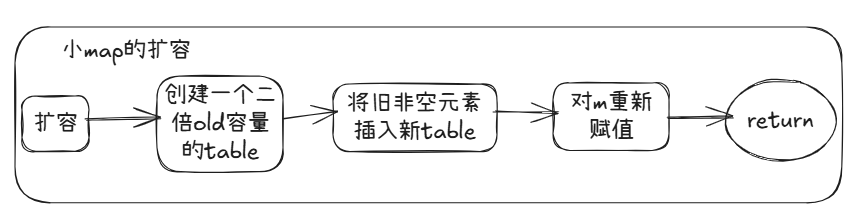 **Map.growToTable()**
该方法用于小map插入slot时扩容使用,
- 首先创建一个容量为2个group数量槽位的table
- 封装一个group指向当前m的group的地址
- 紧接着开启循环处理group中的slot,如果遇到empty slot则continue,对非空槽位取出 key/elem,重新算 hash 后插入新 table
- 处理完当前m的slot,对m的进行重新赋值,结束,进入大map路径
1
2
3
4
5
6
7
8
9
10
11
12
13
14
15
16
17
18
19
20
21
22
23
24
25
26
27func (m *Map) growToTable(typ *abi.SwissMapType) {
tab := newTable(typ, 2*abi.SwissMapGroupSlots, 0, 0)
g := groupReference{
data: m.dirPtr,
}
for i := uintptr(0); i < abi.SwissMapGroupSlots; i++ {
if (g.ctrls().get(i) & ctrlEmpty) == ctrlEmpty {
continue
}
key := g.key(typ, i)
if typ.IndirectKey() {
key = *((*unsafe.Pointer)(key))
}
elem := g.elem(typ, i)
if typ.IndirectElem() {
elem = *((*unsafe.Pointer)(elem))
}
hash := typ.Hasher(key, m.seed)
tab.uncheckedPutSlot(typ, hash, key, elem)
}
directory := make([]*table, 1)
directory[0] = tab
m.dirPtr = unsafe.Pointer(&directory[0])
m.dirLen = len(directory)
m.globalDepth = 0
m.globalShift = depthToShift(m.globalDepth)
}
接着看对小map扩容的时候slot是怎么插入到新table的
table.uncheckedPutSlot()
- 如果table的growthLeft为0 违反则直接panic
- 首先也是获取探测序列和起始group,并进入探测迭代
- 在循环里,首先获得group的空或者已经删除的slot的位图(但官方规定该函数要求table中不存在已删除的slot,所以大概率写入empty slot)
- 如果有则取第一个slot,并拿到第 i 槽位的 key 字段地址,typ.IndirectKey() 为真:槽位里存“指针”,直接把 key 指针写进去;否则typedmemmove 把 key 内容拷贝进槽位; elem同理
- 写入过后t.growthLeft–,t.used++并将该group的控制位写入当前key的h2(hash)返回
- 如果当前group不存在已删除或者空slot则去下一个探测位置的group
1
2
3
4
5
6
7
8
9
10
11
12
13
14
15
16
17
18
19
20
21
22
23
24
25
26
27
28
29
30
31
32
33func (t *table) uncheckedPutSlot(typ *abi.SwissMapType, hash uintptr, key, elem unsafe.Pointer) {
if t.growthLeft == 0 {
panic("invariant failed: growthLeft is unexpectedly 0")
}
seq := makeProbeSeq(h1(hash), t.groups.lengthMask)
for ; ; seq = seq.next() {
g := t.groups.group(typ, seq.offset)
match := g.ctrls().matchEmptyOrDeleted()
if match != 0 {
i := match.first()
slotKey := g.key(typ, i)
if typ.IndirectKey() {
*(*unsafe.Pointer)(slotKey) = key
} else {
typedmemmove(typ.Key, slotKey, key)
}
slotElem := g.elem(typ, i)
if typ.IndirectElem() {
*(*unsafe.Pointer)(slotElem) = elem
} else {
typedmemmove(typ.Elem, slotElem, elem)
}
t.growthLeft--
t.used++
g.ctrls().set(i, ctrl(h2(hash)))
return
}
}
}
大容量map扩容
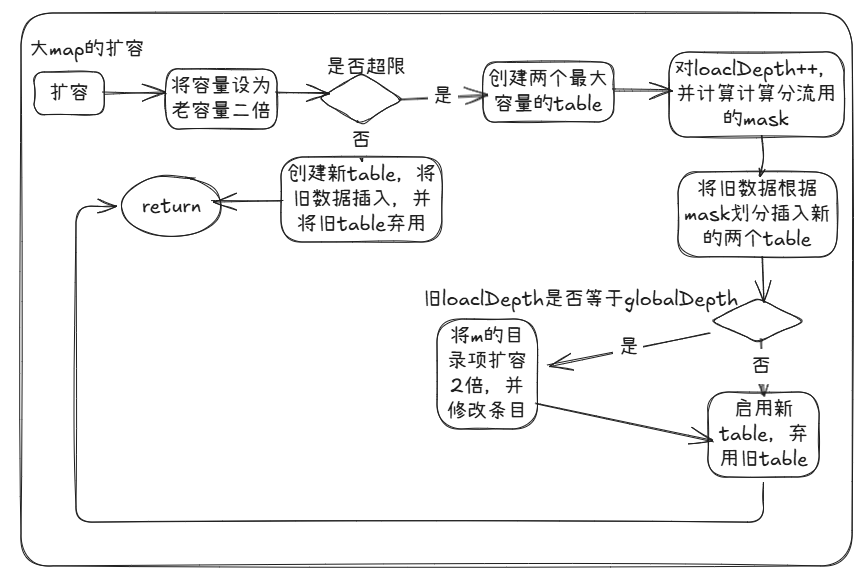 **table.rehash()**
该方法用于大map插入时扩容
**table.rehash()**
该方法用于大map插入时扩容
- 将新newCapacity设为老容量的两倍,没超限制的话调用t.grow(typ, m, newCapacity)然后返回
- 超限制则调用t.split(typ, m)
1
2
3
4
5
6
7
8
9func (t *table) rehash(typ *abi.SwissMapType, m *Map) {
newCapacity := 2 * t.capacity
if newCapacity <= maxTableCapacity {
t.grow(typ, m, newCapacity)
return
}
t.split(typ, m)
}
首先看新容量没超限制的情况:
- 首先根据新容量创建一个table
- 首先判断t.capacity是否大于0,防止capacity==0(零值/异常状态)时去遍历旧 groups 导致错误。只有当t.capacity大于0才会进入处理旧数据
- 处理旧数据跟小map扩容类似,不过大map时遍历groups,对groups中的每个group的slot进行处理,空slot不管,有数据重新hash的插入新table,具体看小map的解释
- 结束前面操作首先检查table的内部状态,然后将m的table换为新table
- 旧table的index设为-1代表已失效,返回
table.grow()1
2
3
4
5
6
7
8
9
10
11
12
13
14
15
16
17
18
19
20
21
22
23
24
25
26
27
28
29func (t *table) grow(typ *abi.SwissMapType, m *Map, newCapacity uint16) {
newTable := newTable(typ, uint64(newCapacity), t.index, t.localDepth)
if t.capacity > 0 {
for i := uint64(0); i <= t.groups.lengthMask; i++ {
g := t.groups.group(typ, i)
for j := uintptr(0); j < abi.SwissMapGroupSlots; j++ {
if (g.ctrls().get(j) & ctrlEmpty) == ctrlEmpty {
continue
}
key := g.key(typ, j)
if typ.IndirectKey() {
key = *((*unsafe.Pointer)(key))
}
elem := g.elem(typ, j)
if typ.IndirectElem() {
elem = *((*unsafe.Pointer)(elem))
}
hash := typ.Hasher(key, m.seed)
newTable.uncheckedPutSlot(typ, hash, key, elem)
}
}
}
newTable.checkInvariants(typ, m)
m.replaceTable(newTable)
t.index = -1
}
table.split()
该方法用于在大map扩容时新容量超出table的限制时将一个table分为两个
- 首先将取出table的localDepth赋值给一个变量,并对该变量++,表示 split 后新表深度 +1
- 然后分别创建left和right两个table,容量时maxTableCapacity,index为-1
- 调用localDepthMask返回一个掩码,用于取哈希值中当前 localDepth 新增出来的那一位(用于 split 时选 left/right)。
- 在处理旧的slot数据时,与直接翻倍容量扩容处理相似,只不过多了一个hash&mask计算落在那一个table,处理结束后调用m.installTableSplit(t, left, right) 把左右表加入目录(必要时先扩目录)。
- 最后将当前table的index设为-1,返回
1
2
3
4
5
6
7
8
9
10
11
12
13
14
15
16
17
18
19
20
21
22
23
24
25
26
27
28
29
30
31
32
33
34
35
36
37
38func (t *table) split(typ *abi.SwissMapType, m *Map) {
localDepth := t.localDepth
localDepth++
left := newTable(typ, maxTableCapacity, -1, localDepth)
right := newTable(typ, maxTableCapacity, -1, localDepth)
mask := localDepthMask(localDepth)
for i := uint64(0); i <= t.groups.lengthMask; i++ {
g := t.groups.group(typ, i)
for j := uintptr(0); j < abi.SwissMapGroupSlots; j++ {
if (g.ctrls().get(j) & ctrlEmpty) == ctrlEmpty {
continue
}
key := g.key(typ, j)
if typ.IndirectKey() {
key = *((*unsafe.Pointer)(key))
}
elem := g.elem(typ, j)
if typ.IndirectElem() {
elem = *((*unsafe.Pointer)(elem))
}
hash := typ.Hasher(key, m.seed)
var newTable *table
if hash&mask == 0 {
newTable = left
} else {
newTable = right
}
newTable.uncheckedPutSlot(typ, hash, key, elem)
}
}
m.installTableSplit(t, left, right)
t.index = -1
}
Map.installTableSplit()
该方法用于将split后的left和right table加入目录项
- 如果old.localDepth == m.globalDepth,说明当前目录项不够再对table进行细分需要对目录进行翻倍(把所有目录项复制扩展,但不会立刻把其他 table 也一起 split)
- 首先创建一个m.dirLen*2长度的 *table切片,然后将每个table的旧索引 i 扩成新索引 2 * i 和 2 * i+1。t.index 存的是该 table 在目录中的第一个位置。同一个 table 可能在目录里出现多次,所以只在遇到它原来的起始位置(t.index == i)时更新一次为 2 * i,避免重复改错。(确保只更新一次每个 table 的起始索引)
- 并对m的一些参数进行对应的修改
- 调用replaceTable将left和right插入到目录项里,entries表示该 table 需要被多少个目录项共享引用。当 m.globalDepth - left.localDepth == 1 时,entries=2,所以 replaceTable 会把 left(或 right)写入连续 2 个目录项。
- 此时right的目录项紧挨着left的目录项
1
2
3
4
5
6
7
8
9
10
11
12
13
14
15
16
17
18
19
20
21
22func (m *Map) installTableSplit(old, left, right *table) {
if old.localDepth == m.globalDepth {
newDir := make([]*table, m.dirLen*2)
for i := range m.dirLen {
t := m.directoryAt(uintptr(i))
newDir[2*i] = t
newDir[2*i+1] = t
if t.index == i {
t.index = 2 * i
}
}
m.globalDepth++
m.globalShift--
m.dirPtr = unsafe.Pointer(&newDir[0])
m.dirLen = len(newDir)
}
left.index = old.index
m.replaceTable(left)
entries := 1 << (m.globalDepth - left.localDepth)
right.index = left.index + entries
m.replaceTable(right)
}
Map.replaceTable()
用来实现同一个 table 被多个目录项共享引用
1 | func (m *Map) replaceTable(nt *table) { |
从map中删除数据
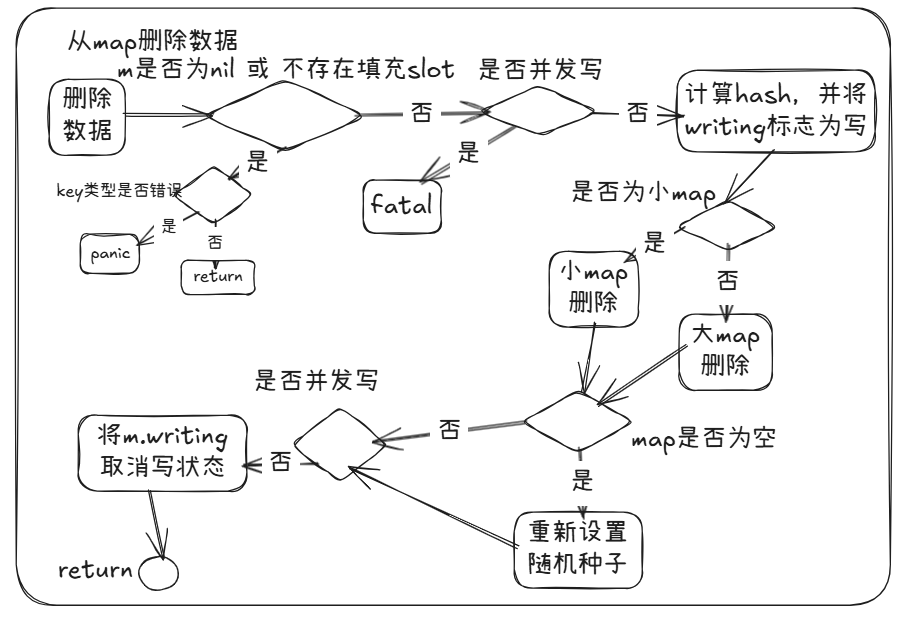
- 如果map为nil,或者map中无已填充的数据,首先对key的合法性进行判断,如果key不合法则直接panic,否则返回;
- 判断是否有其他协程再写map,有的话fatal
- 如没有其他协程写且map不为空则先计算key的hash,并将 m.writing ^= 1
- 接着进入删除操作,小map和大map执行不同操作
- 删除结束,如果 m.used == 0,说明 map 已经空了。重新设置 m.seed = uintptr(rand()),并判断是否有其他协程在过程中进行并发写,有的话fatal,否则m.writing ^= 1返回
Map.Delete()1
2
3
4
5
6
7
8
9
10
11
12
13
14
15
16
17
18
19
20
21
22
23
24
25
26func (m *Map) Delete(typ *abi.SwissMapType, key unsafe.Pointer) {
if m == nil || m.Used() == 0 {
if err := mapKeyError(typ, key); err != nil {
panic(err)
}
return
}
if m.writing != 0 {
fatal("concurrent map writes")
}
hash := typ.Hasher(key, m.seed)
m.writing ^= 1
if m.dirLen == 0 {
m.deleteSmall(typ, hash, key)
} else {
idx := m.directoryIndex(hash)
m.directoryAt(idx).Delete(typ, m, hash, key)
}
if m.used == 0 {
m.seed = uintptr(rand())
}
if m.writing == 0 {
fatal("concurrent map writes")
}
m.writing ^= 1
}
接着看小map删除的具体实现
Map.deleteSmall()
- 首先封装一个group指向m.dirPtr(即存放slot的地址)
- 得到group中与h2(hash)匹配的slot的位图,如果没有直接结束deleteSmall()
- 首先取出第一个与h2匹配的slot的slotKey,并赋值变量方便清除elem,如果slotkey存放的是指向 key 的指针则解引用
- 接着判断Equal(key, slotKey),不相等的话则继续取下一个匹配的slot
- 匹配的话进入清除数据,首先将m.used–,然后判断key是否是存放的是指向 key 的指针,是的话清空指针,切断对key的引用;typ.Key.Pointers() 为真说明 key 本身包含指针字段。这时用 typedmemclr 按类型清零,把 key 里的指针字段清掉,防止残留引用。上述两步都是为了方便gc回收
- 对elem判断elem是否是存放的是指向 elem的指针,是的话清空指针,切断对elem的引用,否则直接按类型清空,返回
1
2
3
4
5
6
7
8
9
10
11
12
13
14
15
16
17
18
19
20
21
22
23
24
25
26
27
28
29
30
31func (m *Map) deleteSmall(typ *abi.SwissMapType, hash uintptr, key unsafe.Pointer) {
g := groupReference{
data: m.dirPtr,
}
match := g.ctrls().matchH2(h2(hash))
for match != 0 {
i := match.first()
slotKey := g.key(typ, i)
origSlotKey := slotKey
if typ.IndirectKey() {
slotKey = *((*unsafe.Pointer)(slotKey))
}
if typ.Key.Equal(key, slotKey) {
m.used--
if typ.IndirectKey() {
*(*unsafe.Pointer)(origSlotKey) = nil
} else if typ.Key.Pointers() {
typedmemclr(typ.Key, slotKey)
}
slotElem := g.elem(typ, i)
if typ.IndirectElem() {
*(*unsafe.Pointer)(slotElem) = nil
} else {
typedmemclr(typ.Elem, slotElem)
}
g.ctrls().set(i, ctrlEmpty)
return
}
match = match.removeFirst()
}
}
最后看大map删除的具体实现
- 首先取探测序列和起始group位置,进入探测循环
- 取起始group,首先得到group中与h2(hash)匹配的slot的位图,如果matchH2 为空后,再看 是否存在空 slot;如果有空 slot,探测序列到此结束直接返回;如果没有空 slot,继续下一个 group。
- 下面主要流程与小map一样,主要说在group查找与小map不一样的地方
- 大 map 删除时会 t.used– 和 m.used–;如果该 group 里已有空 slot,删除位会被设为 ctrlEmpty,并且 t.growthLeft++;否则设为 ctrlDeleted。
- 并且table会有多个group,第一个group没探测到会探测下一个直到结束
table.Delete()1
2
3
4
5
6
7
8
9
10
11
12
13
14
15
16
17
18
19
20
21
22
23
24
25
26
27
28
29
30
31
32
33
34
35
36
37
38
39
40
41
42
43
44
45func (t *table) Delete(typ *abi.SwissMapType, m *Map, hash uintptr, key unsafe.Pointer) {
seq := makeProbeSeq(h1(hash), t.groups.lengthMask)
for ; ; seq = seq.next() {
g := t.groups.group(typ, seq.offset)
match := g.ctrls().matchH2(h2(hash))
for match != 0 {
i := match.first()
slotKey := g.key(typ, i)
origSlotKey := slotKey
if typ.IndirectKey() {
slotKey = *((*unsafe.Pointer)(slotKey))
}
if typ.Key.Equal(key, slotKey) {
t.used--
m.used--
if typ.IndirectKey() {
*(*unsafe.Pointer)(origSlotKey) = nil
} else if typ.Key.Pointers() {
typedmemclr(typ.Key, slotKey)
}
slotElem := g.elem(typ, i)
if typ.IndirectElem() {
*(*unsafe.Pointer)(slotElem) = nil
} else {
typedmemclr(typ.Elem, slotElem)
}
if g.ctrls().matchEmpty() != 0 {
g.ctrls().set(i, ctrlEmpty)
t.growthLeft++
} else {
g.ctrls().set(i, ctrlDeleted)
}
t.checkInvariants(typ, m)
return
}
match = match.removeFirst()
}
match = g.ctrls().matchEmpty()
if match != 0 {
return
}
}
}
迭代器
map保证在遍历过程中同一 goroutine 下可改;并发写会触发 fatal对表进行修改,但不保证这些修改会在遍历中可见。
下面首先看迭代器的数据结构;
迭代器数据结构
1 | type Iter struct { |
- key 槽位对应的key
- elem 槽位对应的elem
- entryOffset 一个随机 slot 偏移开始遍历来打乱遍历顺序
- dirOffset 目录的偏移量使用一个独立的 offset,因为目录增长时需要调整
- clearSeq 用于检测遍历期间是否发生了 Clear
- globalDepth 上一次调用 Next 时 Map.globalDepth 的值,用于检测遍历期间目录是否增长
- dirIdx 当前目录索引,尚未应用 dirOffset 的调整。
- tab 上一次调用 Next 时 dirIdx 对应的 table。
- group 上一次调用 Next 时 entryIdx 对应的 group。
- entryIdx 是当前 entry 的索引,尚未应用 entryOffset 的调整。index 的低 3 位是 slot 索引,高位是 group 索引。
迭代的主流程如下
1 | func mapIterStart(t *abi.SwissMapType, m *maps.Map, it *maps.Iter) { |
在map遍历时首先初始化一个迭代器
- 当map为nil,或者为空时直接结束
- 如果map时小map时,将dirIdx设为-1,并将group设为map的dirPtr存放的数据
- 然后利用rand()分别设置entryOffset和dirOffset偏移和以及初始化其它参数
Iter.Init()1
2
3
4
5
6
7
8
9
10
11
12
13
14
15
16
17
18
19
20
21
22
23func (it *Iter) Init(typ *abi.SwissMapType, m *Map) {
it.typ = typ
if m == nil || m.used == 0 {
return
}
dirIdx := 0
var groupSmall groupReference
if m.dirLen <= 0 {
// Use dirIdx == -1 as sentinel for small maps.
dirIdx = -1
groupSmall.data = m.dirPtr
}
it.m = m
it.entryOffset = rand()
it.dirOffset = rand()
it.globalDepth = m.globalDepth
it.dirIdx = dirIdx
it.group = groupSmall
it.clearSeq = m.clearSeq
}
初始化迭代器结束后进入迭代函数
该方法较长拆分解释:
首先看错误情况
- 首先看m是否为nil,如果为nil则将迭代器的key和elem都设为nil,返回
- 如果在迭代过程有其他的协程在写map,则直接fatal返回
1
2
3
4
5
6
7
8
9
10
11
12
13
14
15
16
17
18
19
20
21
22
23
24
25
26
27
28
29
30
31
32
33
34
35
36
37
38
39
40
41
42
43
44
45
46
47
48
49
50
51
52
53
54
55
56
57
58
59
60
61
62
63
64
65
66
67
68
69
70
71
72
73
74
75
76
77
78
79
80
81
82
83
84
85
86
87
88
89
90
91
92
93
94
95
96
97
98
99
100
101
102
103
104
105
106
107
108
109
110
111
112
113
114
115
116
117
118
119
120
121
122
123
124
125
126
127
128
129
130
131
132
133
134
135
136
137
138
139
140
141
142
143
144
145
146
147
148
149
150
151
152
153
154
155
156
157
158
159
160
161
162
163
164
165
166
167
168
169
170
171
172
173
174
175
176
177
178
179
180
181
182
183
184
185
186
187
188
189
190
191
192
193
194
195
196
197
198
199
200
201
202
203
204
205
206
207
208
209
210
211
212func (it *Iter) Next() {
if it.m == nil {
it.key = nil
it.elem = nil
return
}
if it.m.writing != 0 {
fatal("concurrent map iteration and map write")
return
}
//小map的迭代对应step1
if it.dirIdx < 0 {
// Map was small at Init.
for ; it.entryIdx < abi.SwissMapGroupSlots; it.entryIdx++ {
k := uintptr(it.entryIdx+it.entryOffset) % abi.SwissMapGroupSlots
if (it.group.ctrls().get(k) & ctrlEmpty) == ctrlEmpty {
continue
}
key := it.group.key(it.typ, k)
if it.typ.IndirectKey() {
key = *((*unsafe.Pointer)(key))
}
grown := it.m.dirLen > 0
var elem unsafe.Pointer
if grown {
var ok bool
newKey, newElem, ok := it.m.getWithKey(it.typ, key)
if !ok {
if it.clearSeq == it.m.clearSeq && !it.typ.Key.Equal(key, key) {
elem = it.group.elem(it.typ, k)
if it.typ.IndirectElem() {
elem = *((*unsafe.Pointer)(elem))
}
} else {
continue
}
} else {
key = newKey
elem = newElem
}
} else {
elem = it.group.elem(it.typ, k)
if it.typ.IndirectElem() {
elem = *((*unsafe.Pointer)(elem))
}
}
it.entryIdx++
it.key = key
it.elem = elem
return
}
it.key = nil
it.elem = nil
return
}
//大map在迭代期间扩容对应step2
if it.globalDepth != it.m.globalDepth {
orders := it.m.globalDepth - it.globalDepth
it.dirIdx <<= orders
it.dirOffset <<= orders
it.globalDepth = it.m.globalDepth
}
//大map的迭代对应step3
for ; it.dirIdx < it.m.dirLen; it.nextDirIdx() {
if it.tab == nil {
dirIdx := int((uint64(it.dirIdx) + it.dirOffset) & uint64(it.m.dirLen-1))
newTab := it.m.directoryAt(uintptr(dirIdx))
if newTab.index != dirIdx {
diff := dirIdx - newTab.index
it.dirOffset -= uint64(diff)
dirIdx = newTab.index
}
it.tab = newTab
}
entryMask := uint64(it.tab.capacity) - 1
if it.entryIdx > entryMask {
continue
}
entryIdx := (it.entryIdx + it.entryOffset) & entryMask
slotIdx := uintptr(entryIdx & (abi.SwissMapGroupSlots - 1))
if slotIdx == 0 || it.group.data == nil {
groupIdx := entryIdx >> abi.SwissMapGroupSlotsBits
it.group = it.tab.groups.group(it.typ, groupIdx)
}
if (it.group.ctrls().get(slotIdx) & ctrlEmpty) == 0 {
key := it.group.key(it.typ, slotIdx)
if it.typ.IndirectKey() {
key = *((*unsafe.Pointer)(key))
}
grown := it.tab.index == -1
var elem unsafe.Pointer
if grown {
newKey, newElem, ok := it.grownKeyElem(key, slotIdx)
if !ok {
goto next
} else {
key = newKey
elem = newElem
}
} else {
elem = it.group.elem(it.typ, slotIdx)
if it.typ.IndirectElem() {
elem = *((*unsafe.Pointer)(elem))
}
}
it.entryIdx++
it.key = key
it.elem = elem
return
}
next:
it.entryIdx++
var groupMatch bitset
for it.entryIdx <= entryMask {
entryIdx := (it.entryIdx + it.entryOffset) & entryMask
slotIdx := uintptr(entryIdx & (abi.SwissMapGroupSlots - 1))
if slotIdx == 0 || it.group.data == nil {
groupIdx := entryIdx >> abi.SwissMapGroupSlotsBits
it.group = it.tab.groups.group(it.typ, groupIdx)
}
if groupMatch == 0 {
groupMatch = it.group.ctrls().matchFull()
if slotIdx != 0 {
groupMatch = groupMatch.removeBelow(slotIdx)
}
if groupMatch == 0 {
it.entryIdx += abi.SwissMapGroupSlots - uint64(slotIdx)
continue
}
i := groupMatch.first()
it.entryIdx += uint64(i - slotIdx)
if it.entryIdx > entryMask {
continue
}
entryIdx += uint64(i - slotIdx)
slotIdx = i
}
key := it.group.key(it.typ, slotIdx)
if it.typ.IndirectKey() {
key = *((*unsafe.Pointer)(key))
}
grown := it.tab.index == -1
var elem unsafe.Pointer
if grown {
newKey, newElem, ok := it.grownKeyElem(key, slotIdx)
if !ok {
groupMatch = groupMatch.removeFirst()
if groupMatch == 0 {
it.entryIdx += abi.SwissMapGroupSlots - uint64(slotIdx)
continue
}
i := groupMatch.first()
it.entryIdx += uint64(i - slotIdx)
continue
} else {
key = newKey
elem = newElem
}
} else {
elem = it.group.elem(it.typ, slotIdx)
if it.typ.IndirectElem() {
elem = *((*unsafe.Pointer)(elem))
}
}
groupMatch = groupMatch.removeFirst()
if groupMatch == 0 {
it.entryIdx += abi.SwissMapGroupSlots - uint64(slotIdx)
} else {
i := groupMatch.first()
it.entryIdx += uint64(i - slotIdx)
}
it.key = key
it.elem = elem
return
}
}
it.key = nil
it.elem = nil
return
}
step1: 小map的迭代处理逻辑:
这段代码块逻辑也比较复杂拆开来讲
首先可以肯定的是it.dirIdx < 0只有小map才会出现,并且此时entryIdx是为0
首先是获得迭代器取到的slot的key的逻辑
- 使用entryIdx结合entryOffset 随机取到一个index,如果对应slot为空或者被删除则进行下一轮循环
- 否则取出index对应的key,如果slotkey存放的是指向key地址的指针则解引用
1
2
3
4
5
6
7
8
9
10if it.dirIdx < 0 {
for ; it.entryIdx < abi.SwissMapGroupSlots; it.entryIdx++ {
k := uintptr(it.entryIdx+it.entryOffset) % abi.SwissMapGroupSlots
if (it.group.ctrls().get(k) & ctrlEmpty) == ctrlEmpty {
continue
}
key := it.group.key(it.typ, k)
if it.typ.IndirectKey() {
key = *((*unsafe.Pointer)(key))
}
然后是取slot key对应的slot elem的逻辑
- grown == false 时直接从旧 group 取 elem(必要时解引用);grown == true 时必须 getWithKey 去新表取 newKey/newElem。
- getWithKey 失败时的处理是:若 clearSeq 变了(发生 Clear)直接 continue;若 没 Clear 且 key != key(NaN 情况)才回退用旧 group 的 elem;否则 continue。
- key != key 不仅限于纯 float key,结构体/数组里含 NaN 也会触发。
- 返回时会把 it.elem 和 it.key 设置好,并 entryIdx++。
- 循环结束直接将it.elem 和 it.key 设置 nil,并返回
1
2
3
4
5
6
7
8
9
10
11
12
13
14
15
16
17
18
19
20
21
22
23
24
25
26
27
28
29
30
31
32
33grown := it.m.dirLen > 0
var elem unsafe.Pointer
if grown {
var ok bool
newKey, newElem, ok := it.m.getWithKey(it.typ, key)
if !ok {
if it.clearSeq == it.m.clearSeq && !it.typ.Key.Equal(key, key) {
elem = it.group.elem(it.typ, k)
if it.typ.IndirectElem() {
elem = *((*unsafe.Pointer)(elem))
}
} else {
continue
}
} else {
key = newKey
elem = newElem
}
} else {
elem = it.group.elem(it.typ, k)
if it.typ.IndirectElem() {
elem = *((*unsafe.Pointer)(elem))
}
}
it.entryIdx++
it.key = key
it.elem = elem
return
}
it.key = nil
it.elem = nil
return
}
step2: 在迭代大map之前 it.globalDepth != it.m.globalDepth (说明map在迭代时扩容目录)
- 则将目录项和目录偏移按位数差左移,适配目录扩容后的索引空间。
- 将迭代器的globalDepth更新为新的globalDepth
1
2
3
4
5
6if it.globalDepth != it.m.globalDepth {
orders := it.m.globalDepth - it.globalDepth
it.dirIdx <<= orders
it.dirOffset <<= orders
it.globalDepth = it.m.globalDepth
}
step3: 大map的迭代
此代码块也较多拆解分析:首先开启一个for循环,迭代的时候使用nextDirIdx()跳过整个重复区间会按该 table 在目录中出现的次数来跳转
- 如果it.tab为空则说明第一次迭代,首先根据dirIdx和dirOffset计算出table的index,然后得到对应table
- 如果table的index(在map的首个记录项)与dirIdx不同说明没有落在该table的起始目录项
- 则把 dirIdx 调回到该 table 的首个索引,并同步回退 dirOffset,保证后续迭代不会重复或错位。并将取出的table赋值给迭代器
1
2
3
4
5
6
7
8
9
10
11for ; it.dirIdx < it.m.dirLen; it.nextDirIdx() {
if it.tab == nil {
dirIdx := int((uint64(it.dirIdx) + it.dirOffset) & uint64(it.m.dirLen-1))
newTab := it.m.directoryAt(uintptr(dirIdx))
if newTab.index != dirIdx {
diff := dirIdx - newTab.index
it.dirOffset -= uint64(diff)
dirIdx = newTab.index
}
it.tab = newTab
}
如果entryidx已经超过该表的最大 entry 索引,就结束这张表,转到下一张表。
1 | entryMask := uint64(it.tab.capacity) - 1 |
接着看快速处理路径
- 首先根据it.entryIdx和entryOffset计算entryIdx(低三位用于slot,高位用于group)
- 然后根据entryIdx计算slotidx,在开始遍历这张表的第一次迭代时,需要计算一次group,slotidx从末尾绕到首位时说明开启下一组也需要计算一次group,计算group使用到了entryIdx
- 获得group后,对slotIdx的控制位进行判别是否为存在值的,如果不是则进入慢路径
- 如果存在值则进入if执行,首先根据slotIdx在group取出slotkey(如果是指向key指针解引用)
- 接着判断table是否触发扩容,倘若触发扩容去新表根据slotIdx取出newKey, newElem,如果取到赋值给key和elem,没取到则进入慢路径
- 若没扩容则直接去group取elem(如果是指向elem指针解引用)
- 最后给迭代器更新值,返回
1
2
3
4
5
6
7
8
9
10
11
12
13
14
15
16
17
18
19
20
21
22
23
24
25
26
27
28
29
30
31
32
33
34entryIdx := (it.entryIdx + it.entryOffset) & entryMask
slotIdx := uintptr(entryIdx & (abi.SwissMapGroupSlots - 1))
if slotIdx == 0 || it.group.data == nil {
groupIdx := entryIdx >> abi.SwissMapGroupSlotsBits
it.group = it.tab.groups.group(it.typ, groupIdx)
}
if (it.group.ctrls().get(slotIdx) & ctrlEmpty) == 0 {
key := it.group.key(it.typ, slotIdx)
if it.typ.IndirectKey() {
key = *((*unsafe.Pointer)(key))
}
grown := it.tab.index == -1
var elem unsafe.Pointer
if grown {
newKey, newElem, ok := it.grownKeyElem(key, slotIdx)
if !ok {
goto next
} else {
key = newKey
elem = newElem
}
} else {
elem = it.group.elem(it.typ, slotIdx)
if it.typ.IndirectElem() {
elem = *((*unsafe.Pointer)(elem))
}
}
it.entryIdx++
it.key = key
it.elem = elem
return
}
接着我们来看慢路径是怎么处理
将entryIdx++(因为在前面流程中entryIdx游标没有取到值)
如果it.entryidx已经超过该表的最大 entry 索引,就结束这张表,转到下一张表。
否则进入匹配首先根据it.entryIdx和entryOffset计算entryIdx(低三位用于slot,高位用于group)
然后根据entryIdx计算slotidx,在开始遍历这张表的第一次迭代时,需要计算一次group,slotidx从末尾绕到首位时说明开启下一组也需要计算一次group,计算group使用到了entryIdx
1
2
3
4
5
6
7
8
9
10
11
12
13next:
it.entryIdx++
var groupMatch bitset
for it.entryIdx <= entryMask {
entryIdx := (it.entryIdx + it.entryOffset) & entryMask
slotIdx := uintptr(entryIdx & (abi.SwissMapGroupSlots - 1))
if slotIdx == 0 || it.group.data == nil {
groupIdx := entryIdx >> abi.SwissMapGroupSlotsBits
it.group = it.tab.groups.group(it.typ, groupIdx)
}
//..
对group寻找不为空的slot的位图(当第一次进入迭代时)
如果slotidx不为0则清除匹配得到位图的低位,只留下 slot i 及之后的位。
如果位图为0(无可用的slot),则跳过该group剩余槽位,转到下一轮循环
找到第一个可用slot,把线性游标前进到这个位置
如果游标超过表尾,下一轮处理回绕。
同步更新带 offset 的实际索引。以及更新slotIdx,后续就用去取 key/elem。
1
2
3
4
5
6
7
8
9
10
11
12
13
14
15
16
17if groupMatch == 0 {
groupMatch = it.group.ctrls().matchFull()
if slotIdx != 0 {
groupMatch = groupMatch.removeBelow(slotIdx)
}
if groupMatch == 0 {
it.entryIdx += abi.SwissMapGroupSlots - uint64(slotIdx)
continue
}
i := groupMatch.first()
it.entryIdx += uint64(i - slotIdx)
if it.entryIdx > entryMask {
continue
}
entryIdx += uint64(i - slotIdx)
slotIdx = i
}根据slotidx取到slotkey(如果是指向key的指针则解引用)
接着判断当前表在迭代时是否发生扩容,即(t.tab.index == -1(发生扩容时会将table的index设为-1)),没扩容的话直接在迭代器的group中取elem(如果是指向elem指针解引用)
扩容的话,去新table查询,查到则直接赋值
新table没查到的话,将位图第一个匹配的slot移除,接着判断位图是否还有值,没值的话将跳过该group剩余槽位,转到下一轮循;
如果位图还有值则接着取和更新游标
在前面取完值以后执行和新table没查到情况相同判断,不过此时已经去到值可以给elem和key赋值返回
1
2
3
4
5
6
7
8
9
10
11
12
13
14
15
16
17
18
19
20
21
22
23
24
25
26
27
28
29
30
31
32
33
34
35
36
37
38
39
40
41key := it.group.key(it.typ, slotIdx)
if it.typ.IndirectKey() {
key = *((*unsafe.Pointer)(key))
}
grown := it.tab.index == -1
var elem unsafe.Pointer
if grown {
newKey, newElem, ok := it.grownKeyElem(key, slotIdx)
if !ok {
groupMatch = groupMatch.removeFirst()
if groupMatch == 0 {
it.entryIdx += abi.SwissMapGroupSlots - uint64(slotIdx)
continue
}
i := groupMatch.first()
it.entryIdx += uint64(i - slotIdx)
continue
} else {
key = newKey
elem = newElem
}
} else {
elem = it.group.elem(it.typ, slotIdx)
if it.typ.IndirectElem() {
elem = *((*unsafe.Pointer)(elem))
}
}
groupMatch = groupMatch.removeFirst()
if groupMatch == 0 {
it.entryIdx += abi.SwissMapGroupSlots - uint64(slotIdx)
} else {
i := groupMatch.first()
it.entryIdx += uint64(i - slotIdx)
}
it.key = key
it.elem = elem
return
}
如果大map没取到值则返回nil,小map没取到值得情况在前面已经提前终止
1 | it.key = nil |
go 新存储方式map的解读到此结束,谢谢阅读!